
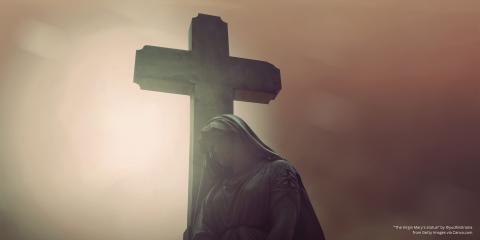
[Note: The following material was published by NACMS in 2004 as part of The Armbruster Collection, Monograph Series—Document No. 50—pp. 103-21. It is now provided to you in electronic format as an aid on your Lenten journey and as a way to educate the Marianist Family on the origins and meaning of the Three O’Clock Prayer.]
Click here for a downloadable PDF version of this article.
Marianist tradition attributes to the Founder the origin of the Three O’Clock Prayer. The editor of the Spirit of Our Foundation states that “this prayer is present in all the works of the Founder.” Yet, somewhat curiously, when he enumerates these works, Father Henri Lebon passes directly from the Miséricorde to the first elite groups within the Sodality and to the projects for “religious living in the world.”[1]
Obviously the first implication is clear: The Sodality of Bordeaux, at its beginnings, did not have this tradition. In fact, the prayer is not mentioned in any text of the early Sodality (1801-9).
It, therefore, seems important to reexamine the texts in chronological order to see what they might reveal on the history of the Three O’Clock Prayer. That is properly the intent of this article. Because history ought to enlighten our attempts at renewal today, I will take the liberty of expressing, as a kind of conclusion, two proposals.
1. Origins of Our Three O’Clock Prayer
There is no spiritual text of the Founder from before the Revolution that contains any trace of a special devotion or prayer for three o’clock in the afternoon. The Rules of the Congregation of Priests and Clerics Under the Patronage of Saint Charles, adopted and lived by the Chaminade brothers at Mussidan, has no sign of such a prayer. And Bernard Xavier Daries, disciple of the Chaminades at this moment in history, who is otherwise so prolific on devotion to Mary, nowhere speaks of this practice.
a. The Importance of Spiritual Rendezvous
In Bordeaux, under the Great Terror, Father Joseph Boyer, administrator of the diocese, began an association in honor of the Sacred Heart of Jesus whose object was to obtain, through prayer and penance, the conversion of sinners. Many of the laity and all the underground priests, including therefore Chaminade, joined the group. The associates, dispersed here and there, whether in prison or elsewhere, knelt down every day at five o’clock to perform what was called “adoration.” Such is the testimony of Mlle de Lamourous who herself formed part of still another association with even stricter spiritual requirements.[2]
This daily spiritual rendezvous of dispersed members of an association was a source of strength, of union, and of fervor. Chaminade had direct experience of it and throughout his life insisted on such union among the members of his various foundations. So it was that young John Baptiste Lalanne, a member of a core group within the Sodality, in 1809 received a Rule of Life containing the following article:
At noon, the ejaculatory prayer: The most just, the most high, and the most lovable will of God be done, praised, and eternally exalted in all things! At this hour, in the presence of God, the same thought unites all; they pause for a few moments to savor the satisfaction given them by the certitude of mutual remembrance.[3]
A rendezvous at five o’clock, a rendezvous at noon; nothing yet about three o’clock. Yet, on the return of the Founder to Bordeaux from exile in Saragossa (1797-1800), this rendezvous at three o’clock begins to take shape: it is a common prayer inserted into the regulations for the Miséricorde of Bordeaux.
b. Three O’Clock Prayer at the Miséricorde
Already in January of 1801, Mlle de Lamourous, at Chaminade’s oratory at Rue Saint-Simeon and therefore with him, drew up a first draft of a Rule. Soon thereafter two somewhat important additions were made: A Veni Creator in midmorning; and an adoration of the cross with three Ave Marias at three o’clock in the afternoon. In this way, as Father Joseph Verrier points out, “the division of the hours of work, of prayer, of reflection, of silence, and of recreation is better balanced, and each hour is marked by a spiritual practice that helps to sustain the [proper] atmosphere.”
Mlle de Lamourous was well acquainted with the customs of the Carmelites and seems to have taken her inspiration from them. As with the Carmelites, her purpose was to balance prayer and work throughout the day. Even more interesting is the commentary the Foundress herself makes on this prayer at three o’clock, a prayer that came in the middle of a silence period lasting from 2:00 P.M. to 3:45 P.M. Speaking to her filles she writes:
Can we prostrate ourselves at 3:00 o’clock—at the very hour our Savior died—without begging his pardon for having so outraged him, for having, alas, caused him so much pain? What remedy more efficacious than that of embracing, as did Magdalene, the cross covered with the blood our crimes caused him to flow! And how could you, at a moment so ripe for obtaining merciful forgiveness, not ask wholeheartedly for your sincere conversion and, to obtain it, a true contrition for your sins?
During the three Aves commemorating the three sorrowful hours the most loving of mothers passed at the foot of the cross, could we fail to share in her most bitter anguish, we who caused them, we for whom she united them to the bloody sacrifice of her divine Son for the salvation of all and for ours in particular? Let us, therefore, pray these three Aves to thank her, to ask her to obtain for us the courage to make the sacrifices without which her sorrows and the blood of Jesus would be inefficacious for us. Oh, what a misfortune that would be![4]
At the Miséricorde this practice had a name: the Three O’Clock Adoration. The word “adoration” refers, it seems, both to the spiritual rendezvous of the association of the Sacred Heart mentioned above, and also to the adoration of the cross. This adoration was not adopted by the Sodality, despite the fact that Mlle de Lamourous was “Mère” of the entire female section. The Director [Chaminade], though, did love to meditate on and to preach the mystery of Calvary, wherein the contemplation of Mary’s active part held a place of honor.
In some autograph notes of a sermon on The Compassion of the Holy Virgin, we read: “Suffering of Mary on Calvary; motives which led her to be there. . . . Consequences, worthy children of Mary (1) will love Calvary and (2) like Mary, they will choose to be there.”[5] Chaminade’s meditation on the subject of Calvary may have prepared him to accept eventually the devotion of a prayer at three o’clock; in fact, it came to him through the intermediary of the two female Founders: Mlles de Lamourous and de Trenquelléon.
c. The Prayer of Three O’Clock in the Association of Adèle de Trenquelléon
Very early, young Adèle (1788-1828) was led to create, with the help of Monsieur [Jean Baptiste] Ducourneau, tutor of her brother Charles, an association similar to the female Marian Sodalities of before the Revolution. In the Rule of 1804 we read:
At three o’clock in the afternoon every day the Associates gather together in spirit on Calvary to adore the death of Jesus Christ, to unite ours to his, and to make an act of love for the sacred wounds of the Savior. This practice is purely internal and can be done without interrupting one’s occupations or disturbing one’s companions wherever one may be.
Because “the purpose of the society is to obtain a good” death by living a fervent Christian life, Friday, “the day of the death of our Lord Jesus Christ,” was the day chosen for the dispersed members to spend a “few minutes in meditation with the intent of arousing in themselves a desire to die and to rise again with Jesus Christ . . . then, recalling the seven wounds of Jesus Christ, the Ave Maria is recited seven times. These seven wounds are the scourging, the crowning with thorns, and the five wounds inflicted on the cross.”[6] Prior to any contact with the Miséricorde of Bordeaux, which was still unknown to her, Adèle moved in the same direction: each day the Associates were to “adore” Jesus Christ on the cross and to recite several Aves. One begins to suspect a common origin for the practice.
Indeed, while it may be normal that in an association for a good death the members should contemplate and venerate Christ dying, another inspiration must be added to the preceding: one which Adèle, too, received from Carmel. Her frequent contacts with the Carmelites of Agen[7] familiarized her with their usages and their customs. One of these latter prescribed that at 3:00 P.M. the bell should recall the moment of the Savior’s death; each nun, prostrated in her cell, was to unite herself with him for a moment before taking up her work again more recollected.[8]
We can, therefore, say clearly that one of the sources of the three o’clock adoration was certainly the Carmelite tradition. But each of the two Foundresses adapted the practice to the special ends of the respective institute. The Founder was aware of this spiritual practice in the Miséricorde already from 1801; he did not know that of Adèle de Trenquelléon until 1809.
d. The Three O’Clock Prayer and the Foundations of Chaminade: 1809
Toward the end of 1808 Chaminade entered into contact with Adèle de Trenquelléon and her Association. An extensive correspondence was exchanged between them.[9] The Founder became acquainted with the rules of Adèle’s Association and found there the texts cited above. What was his reaction to the idea of this practice of prayer, a spiritual rendezvous, at 3:00 P.M.? No document gives us the slightest hint. Yet, a fact is clear. Before 1809 the Founder never recommended this practice; after that date it appears in his writings.
At the end of 1809 the Sodality of Bordeaux, like all others in France, was suppressed by Napoleon. However, it continued to live in hiding and to strike even deeper roots through various approaches to diverse forms of consecration. Some sodalists were encouraged to live a certain type of “religious state in the world.” The idea of a period of recollection at 3:00 P.M. appears and is developed in several writings concerning these diverse forms of consecration. From those forms, it passed quite naturally into the religious foundations: Daughters of Mary (Agen, 1816); Society of Mary (Bordeaux, 1817); Third Order Regular of the Daughters of Mary (Auch, 1836).
2. Spiritual Rendezvous on Calvary According to Chaminade
After 1809, there are numerous texts from the Founder on this subject. However, it is not always possible to establish a precise chronology for the texts, especially in the case of the earlier ones.
a. Texts on the Religious State in the World: The Rendezvous Takes Shape
An analysis of the texts shows unambiguously that the Founder reserved such a reunion on Calvary to those groups which wanted to live the evangelical counsels of the world, that is, to groups of more committed Christians whose members, dispersed, made a very special consecration to Mary; they needed to experience a deep fraternal union in their common love for Mary who, on Calvary, became their Mother through the testament of Jesus. As the two female Founders had done, so also Chaminade gave this rendezvous on Calvary a very personal touch in keeping with his typical teaching on the spiritual maternity of the maternal mission of Mary.
In an undated and untitled manuscript, Chaminade—having first referred to the consecration of Mary—reserved to those sodalists who had also made a vow of obedience, added: “Every day we mount the heights of Calvary.”[10] This formula indicates a simple collective rendezvous in the presence of Jesus crucified.
When it is a question of the “religious state embraced by Christians dispersed in the world [or] in society,” he proposed among the “common practices: Reunion in spirit at three o’clock in the afternoon in the Heart of Mary pierced by the sword of sorrow.”[11] In a text similar to but also later than these two, Chaminade adds a new thought: “This is approximately the hour in which she gave us birth.”[12] The same view is expressed in one of the “special exercises” of the “Special Reunion in honor of the ten virtues of the Holy Virgin.” There we read: “Reunion in spirit on Calvary at 3:00 P.M. to salute Mary there as our Mother.”[13]
In these early texts a most important word is “reunion.” And gradually the focus is not only on the sufferings of Mary, as it is at the Miséricorde, but also on her maternity of grace. Chaminade takes an even further step when he edits an Extract of the Regulations of the Institute of the Children of Mary, which treats of religious who are called to imitate Mary as patroness and model of the State.[14]
At three o’clock in the afternoon, all will go in spirit to Calvary, there to contemplate the Heart of Mary, their loving Mother, pierced by a sword of sorrow, and to recall the happy moment in which they were given birth.
Mary conceived us at Nazareth, but it was on Calvary at the foot of the cross of Jesus dying that she gave us birth. This is the thought that should occupy all the children of this divine Mother during this reunion of heart and spirit on Calvary at three o’clock . . . the reunion ends with an Ave Maria. At this hour all will suspend or interrupt whatever they are doing, if they can do so without unbecomingness. Those who are alone will kneel down. On Good Friday they will take care to give themselves completely to this prayer and to be united with as many others as possible.[15]
With this “extract” we are faced with certain aspects that are at the beginnings of the first regulations about the Three O’Clock Prayer. There is a “station”—a “break” in one’s occupations; there is a prayer gesture that is the same as at Carmel—kneeling if one is alone; finally, there is a prayer—the Ave Maria that is traditional for the occasion. In this devotion, Good Friday holds a privileged place. All these aspects will find their way into the regulations of the Marianist religious institute.
b. Texts of the Religious Institutes: The Tradition Takes Root
For the Daughters of Mary there is no question at this period of history of the Three O’Clock Prayer being in the Constitutions; it is in the secondary texts, concerned with the use of time. Thus, the General Regulations of the Daughters of Mary (1815):
Note: At three o’clock we transport ourselves in spirit to Mount Calvary, but without interrupting our work; on Fridays, at the same time, we kneel down with the same intentions. This little practice is done each day at the sound of the bell.[16]
For the Associates are now in the convent, and, as at Carmel, there will be the ringing of the bell.
It is not surprising that for Adèle de Trenquelléon, become now Mother Marie de la Conception, this rendezvous on Calvary should have a profound meaning. Since the age of fifteen, she had been familiar with it. And from 1809 onward, Chaminade had taught her to contemplate Mary there. Indeed, contemporary with the first texts on the States, we find Chaminadian expressions flowing from Adèle’s pen:
Oh yes, dear friend, it is by the cross that he [Jesus] makes his [chosen ones] more conformable to himself, that he distinguishes them. Should we then claim any other distinction, we the children of Mary who was pierced by the sword of sorrow?[17]
And here is another interesting fact. For some six months Adèle had been in correspondence with Emilie de Rodat, herself a foundress of a religious institute: “I have a great desire that your institute and ours might form only one!”[18] In the following letter she continued to speak of this projected union. In a postscript she added: “I propose to you that you join us each day at three o’clock. We have a spiritual rendezvous on Calvary without [however] leaving our occupations. This rendezvous is announced by a bell. May you also be there yourself, my dear sister; our whole congregation is there as well.”[19] And so this rendezvous on Calvary became a concrete witness to a spiritual reunion, an expression of their desire for union, a prayer common to two congregations seeking to become one.
In the Society of Mary the earliest text seems to be that of the Regulations for the Religious of Mary (1819) where we read:
4. Every day at three o’clock in the afternoon each one makes a short ejaculatory prayer; each one remains standing wherever he may be; only on Friday does he kneel down.[20]
And in the Constitutions of the Society of Mary of 1829 and of 1839 there is an almost identical text:
120. At three o’clock in the afternoon the sound of a bell reminds all the religious to recollect themselves for some moments in order to transport themselves in spirit to the foot of the cross, and there to renew with fervor their devotedness to Jesus and Mary, in memory of that hour of salvation when the dying Jesus gave us as children to his Mother.[21]
With very minor changes, this text of the Founder was to pass into all the successive editions of our Constitutions until 1967.
A final text is that of the General Regulations given to the novitiate of Saint Laurent at Bordeaux in 1841. It is a beautiful synthesis of the meaning of the Three O’Clock Prayer. For the first time, Saint John is present:
At three o’clock the bell of the house announces the Calvary prayer. It is the signal for the rendezvous to which all the religious of Mary have pledged themselves, [to be] at the foot of the cross with the Holy Virgin and Saint John. In the sentiments of faith with which we all transport ourselves in spirit to Calvary, we seem to witness the great sacrifice of the Man-God; the august Virgin is desolate, and Saint John, the well-beloved disciple, is in an ecstasy of pain and love. Each of us even seems to hear the divine Master recalling to our Mother, who does not forget it, that we are her children: Mother, this is your son.
This practice is done standing on ordinary days; kneeling on Fridays; on Good Friday, it takes place in the chapel. It lasts but a few moments.[22]
From this time forward, the tradition was firmly rooted in the religious institutes founded by Chaminade. Let us now review the process by which it has come down to us.
3. The Three O’Clock Prayer from 1850 to Our Time
After the death of Father Chaminade in 1850, the history of the Three O’Clock Prayer has to do primarily with the expressions used, and with its extension to the pupils of our schools.
a. The Expressions Used in the Three O’Clock Prayer
Originally, it seems that the spiritual rendezvous on Calvary used only the Ave Maria as a formula; the rest was a matter of recollection and personal prayer. An early, probably first, formula is found in the Formulary of Vocal Prayers in Use in the Society of Mary[23] where it is called “Prayer of Three O’Clock.” It reads:
My God, I transport myself in spirit to Mount Calvary to watch you render your last breath and to ask your pardon for my sins, which are the cause of your death. (2 minutes).
Act of Contrition
My God, I repent with all my heart of all the sins I have committed against your adorable majesty; I detest them all because you are good and sin displeases you; I make a firm purpose not to repeat them, with the help of your grace and in order to satisfy your justice.
(Then one adds:) I thank you, O divine Jesus, that it has pleased you to give me the most holy Virgin for my Mother; give me the grace to imitate her virtues. And you, O holy Virgin, my good Mother, take me under your special protection and obtain for me that of your beloved son Jesus.
Ave Maria, etc.
May the Father, the Son, and the Holy Spirit. . . .
This formula expresses what was indicated in the General Regulations of 1841: contemplation of the sacrifice of the Savior and recollection that Jesus gave us his Mother and that we are her sons.
With the new Formulary, revised under the guidance of Father Simler, a new formula for the Three O’Clock Prayer was offered to the whole Society of Mary:
P. O my God, we transport ourselves in spirit to Mount Calvary to ask your pardon for our sins which are the cause of your death.
We thank you, O divine Jesus, for having thought of us in that solemn moment, and for having given us as sons to your own Mother.
Holy Virgin, show yourself our Mother by taking us under your maternal protection. And you, Saint John, be our patron and our model
by obtaining for us the grace of imitating your filial piety toward Mary, our Mother.C. Amen.
P. May the Father, etc.
P. In the name of the Father, etc.
Certain directives accompanied this new formula:
This prayer is said kneeling on Friday, standing on other days.
If circumstances prevent the teacher from saying this prayer at three o’clock, he will content himself with having the pious intention of doing so; as soon as he is free, he will compensate for it by a short visit [to the chapel], and he will recite it then.[24]
Why has the formula changed? Simler himself gave the explanation in the circular in which he presented and commented on the new Formulary:
In this new edition, the so-called Three O’Clock Prayer has been shortened so that it is scarcely longer than some ejaculatory prayers; for this reason, it will be easier to recite it without notable interruption of one’s work.
Some religious had expressed regret that there had been no prayer to the Apostle John in the Formulary. We have responded to their concern, and without doubt to the intimate desires of all, by recalling, together with the names of Jesus and Mary, that of Saint John, the well-beloved disciple who followed his Master and remained with him at the cross, the most outstanding among the children of Mary, the apostle of the Heart of Jesus, of the holy Eucharist, of the Passion, and of charity and, in all these respects, our patron and our model.
This Three O’Clock Prayer is a devotion characteristic of the Society of Mary, and for this reason, it should be dear to us. Let it suffice to add that the ringing of the bell is integral to this devotion (Const, art. 83) and that this pious signal should not be omitted in any of our houses.[25]
From this time on, the exact hour was no longer strictly observed. The prayer was said by the President (P), and the Community (C) responded. Soon thereafter, the formula of 1885 was amended to give us our present text. And this year (Armbruster’s article is of 1985) we can celebrate its centenary!
b. Extension of the Three O’Clock Prayer to Our Pupils
This historical overview would be incomplete if it did not also mention the efforts since 1857 to associate our pupils with this devotion, so as to spread it beyond our own communities. The first explicit indication [of this intent] is found in the Manual of Christian Pedagogy Used by the Brothers-Teachers of the Society of Mary.[26] Under the heading “on prayer” we read the following. “At three o’clock the sound of a bell recalls to the teachers and to the pupils that hour of salvation in which Jesus dying gave us as children to his Mother; in all the classes, the prayer given in the Formulary of the Society of Mary is recited aloud.”
It seems this prescription was not fully observed. A handwritten note inserted into the 1868 text of the Constitutions of the Society, with a view to a further revision of the document proposed: “It would be good to establish this custom even among the pupils.”[27]
At the beginning of the twentieth century this concern was taken up again by the General Chapter of 1920; it agreed that the Three O’Clock Prayer should be recited in all the classes where the practice was possible. Then the chapter of 1928 returned to the subject, renewing the recommendation of 1920 and suggesting that the Provincial Administrations have the Three O’Clock Prayer printed on the reverse of a holy card to be distributed in the classrooms and in other environments open to our influence.
So it was that the Three O’Clock Prayer was available to all who wished to pray it. It was in the public domain, available to all. Whereas originally, with the Founder, three o’clock had been the hour of spiritual rendezvous for persons dedicated by a very special consecration. Such is the role of history: it has made common and reduced to a mere formula of prayer what had [originally] been a special time of renewal and communion with Christ on the cross, with Mary and with John who were so close with the Savior in that Hour of salvation.
A certain movement of return to the origins can be found in the text of the Constitutions of 1967. They set aside the old formula and present the Three O’Clock Prayer as “the spiritual reunion of all the religious of the Society of Mary” (art. 95). As for the text of 1983, there is only a simple mention of “the Three O’Clock Prayer, spiritual reunion of all Marianists” (Rule, art. 4.7).
4. Proposals
In these times of renewal and of respect for history, a double proposal might be made to all Marianists: brothers, sisters, and laity. First of all, let us give back to the “rendezvous” of three o’clock its meaning of communion both with Mary, so closely united to Jesus our Savior on the cross, and among all of us who, together, have pledged ourselves in a very special way to “assist” Mary in the maternal mission confided to her by her son. In practice, such a procedure implies a moment of silent recollection to reanimate fervor and to unite ourselves with all other Marianists around the world.
Secondly, let us express in a renewed formula the richness of this practice, profiting from recent studies concerning the mystery of Calvary. From these perspectives, the community of the Madeleine in Bordeaux offers the following text:
Lord Jesus,
Behold us here united at the foot of the cross
with your Mother and the disciple you loved.
We ask your pardon for our sins
which are the cause of your death.
We thank you
for having thought of us in that hour of salvation
and for having given us Mary as our Mother.Holy Virgin,
take us under your protection
and render us open to the action of the Holy Spirit.Saint John,
obtain for us the grace
of accepting Mary into our lives
and of assisting her in her mission. Amen.May the Father and the Son and the Holy Spirit
be glorified in all places
by the Immaculate Virgin Mary.
A few comments may help us appreciate more this new proposed formula:
- your Mother, the disciple: greater fidelity to the text of John’s Gospel (Jn 19:25-27), where these persons are presented in their relationship with Jesus on the cross.
- this hour of salvation: expression of the Founder. The importance of the “hour” in the Gospel of John: hour of Jesus, but also, according to recent studies, hour of the Woman.
- having given us Mary as our Mother: the older formula; inclusive language.
- your protection: a very Chaminadian notion that, in the Founder’s thought, relates to the maternal mission of Mary on our behalf. The protection of Mary is source of our confidence in her, of our courage in her service.
- open to the action of the Holy Spirit: another aspect of Mary’s mission: to form us into the resemblance of her son by rendering us open, as she was, to the divine action of the Pentecostal Spirit.
- accepting Mary into our lives: as John accepted her into his own [house], into his [life of] faith, into his life of disciple of Jesus. Mary is
- given by our Savior: “behold your Mother”; like John, we receive her as a “gift from God,” our gift from God.
- assisting her: recalls our “alliance with Mary.” “We have committed ourselves to Mary . . . to love her, to respect her, to obey her, to assist her. O, above all, we have committed ourselves to this last effect of filial love: assistance, benevolent action.”[28]
- May the Father . . . : This Chaminadean doxology has been the conclusion of all the successive formulas of the Three O’Clock Prayer. May it continue to be such, for everything is for the glory of the most Holy Trinity.
♦♦♦♦
I am pleased to be able to share with all the members of the Marianist Family the results of this research and of the work of our community. I hope that, in our daily living, this spiritual rendezvous on Calvary may be, or may become again, a time when all Marianists, religious and lay, are invited to “renew with fervor their devotedness to Mary,” to draw from it, in the midst of each day and by a loving glance at Christ Redeemer, additional generosity to render better service to the Church, Maria duce.
- Spirit 1, § 154, p. 197.
- Positio Mariae Teresiae Carolae de Lamourous (Romae: Sacra Congregatio Pro Causis Sanctorum Officium Historicum, 1978), p. 51; Joseph Verrier, SM, Jalons: The English Translation of Jalons d’histoire sur la route de Guillaume-Joseph Chaminade, Doc. 46, vol. 1 (Dayton, OH: NACMS, 2001), p. 171. The English translation is comprised of four volumes.
- Jalons 2, p. 54. The same text is located in Spirit 3, § 191, p. 192. It is possible that these spiritual reunions expressing very strong fraternal bonds were inspired by the Rules of the AA. See Verrier, La Congrégation Mariale de M. Chaminade (Fribourg, Switzerland: Regina Mundi, 1964), vol. 1, p. 136.
- Positio . . . de Lamourous, pp. 114-15; p. 117, note 74.
- MW 1, § 216, p. 92.
- Positio Adelaidis de Batz de Trenquelleon (Romae: Sacra Congregatio Pro Causis Sanctorum Officium Historicum, 1974), pp. 51-52. Henri Rousseau, Adèle de Trenquelléon, Fondatrice de l’Institut des Filles de Marie Immaculée et son Oeuvre (Paris: Beauchesne, 1921), pp. 101-3.
- Rousseau, Adèle de Trenquelléon, pp. 82-84 and Note P, p. 722.
- Positio . . . de Trenquelléon, p. 164.
- See Chaminade, Letters, no. 31 and following. The earliest extant letter from Adèle to Chaminade dates from Dec. 28, 1816. See Letters of Adèle, no. 312 and following.
- MW 2, § 375, p. 134; cf. § 374, note 33.
- MW 2, §§ 361, 368; pp. 129, 131. See a similar text in Lalanne’s Rule of Life, 1812, quoted in Spirit 3, § 217, no. 6, p. 267.
- MW 2, § 383, p. 136.
- Documents du P. Chaminade sur l’Etat, édition polycopiée (Fribourg, Switzerland: Séminaire marianiste, 1960), p. 30.
- 14 See a similar text, but much abridged, in Notes on the Institute, quoted in MW 2, § 341 and note 2, p. 123.
- Quoted in MW 2, § 372, pp. 132-33. For the complete text, see Documents du P. Chaminade sur l’Etat, pp. 16-18; the same text, minus one paragraph, is in Spirit 3, § 227, pp. 287-97.
- This text has not been published. The quote is found at the beginning, in the Daily Regulations.
- Adèle, Letters, no. 260 to Agathe Diché, Dec. 28, 1814; vol. 1, p. 268.
- Adèle, Letters, no. 360, to Mother Emilie de Rodat, Jan. 4, 1820; vol. 2, p. 64.
- Adèle, Letters, no. 364, to Mother Emilie de Rodat, Jan. 29, 1820; vol. 2, p. 70.
- MW 2, § 566.4, p. 222; Spirit 2, § 805, p. 382.
- MW 2, § 584, p. 228 with parallel texts of 1829 and 1839.
- MW 2, § 631; for the complete text of the Regulations, see Chaminade, MD 3, §§ 241-301, pp. 104-16.
- Formulaire des Prières Vocales à lúsage de la Société de Marie (Bordeaux: Gounouilhou, 1856), p. 161.
- Formulaire des prières vocales en usage dans la Société de Marie (Paris: Goupy et Jourdan, 1885), pp. 84-85.
- Joseph Simler, SM, Circ. 35, Oct. 21, 1885, p. 7.
- Part Two of Methods d’enseignement (Bordeaux: Lafargue, 1857), p. 77.
- Copy preserved at the Centre Chaminade of Bordeaux, at the Madeleine.
- “Retreat of l8l9: Twelfth Meditation” located in MW 2, § 752, p. 299.