
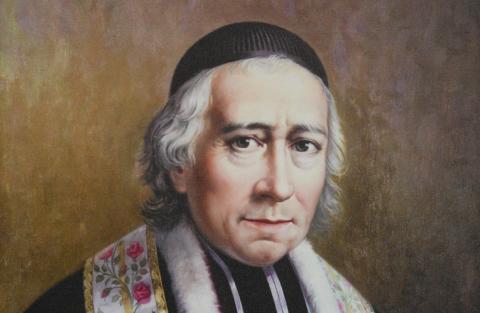
How was it that major setbacks—the French Revolution and organizational hurdles in re-Christianizing France—did not cripple the Founder with anxiety and fear? How was it that Chaminade pushed through obstacles into greater holiness. (A letter Chaminade wrote to Marie Thérèrse de Lamourous serves as a backdrop to this conversation.)
Click here for a downloadable PDF version of this article.
Introduction
Life has its “ups” and its “downs.” The news media are full of all sorts of disquieting developments in our world. What is true today may not be the case tomorrow, and we often feel as if we are on the brink of disaster, no matter our particular political, social, or religious viewpoint. There are multiple challenges in daily life as well, and in our commitment to righteousness and justice we meet the kind of opposition and difficulties Jesus predicted. If all this were not enough, we are in the midst of a serious global pandemic with a wide range of views about how to deal with it or whether it is even necessary to deal with it.
If we take our call to mission seriously, it will bring us to the edge of anxiety, tension, and conflict. How do we persevere in the call to mission without despairing, without becoming bitter, and without abandoning our call to compassion that impels us toward justice? The July Newsletter of the Eastern African Center for Marianist Studies in Nairobi sparked a question that grew into a reflection on Father Chaminade’s response to the difficulties he experienced. Perhaps this reflection can help us in our own responses to what Chaminade called the “chaos of events.” In comments to Mlle Marie Thérèse de Lamourous as he was about to depart from Bordeaux for exile in Spain, Father Chaminade asks and gives his answer to what a faithful soul is to do when events seem to swallow it up.
Mr. Anthony Garascia, former president of the International Organization of Marianist Lay Communities and a professional counselor, and Brother Timothy Phillips, SM, assistant in the novitiate of the Society of Mary in Limuru, Kenya, and assistant director at the Eastern African Center for Marianist Studies in Nairobi, reflect on this question.
Anthony Garascia (Tony):
Somewhere down the line, Brother Tim, give your reflections on Father Chaminade facing death and how he did not grow bitter, fearful, or a man of tyranny, one who dominates others out of fear, like so many do when they are jaded by the cruelties of life. Especially with the Jansenist movement in the background, how did he remain so hopeful in the midst of so many bad things happening? Understanding this would be very relevant for our fearful and changing times.
The reason I ask is that it seems the world is moving into more perilous times, with threats to the human community on a global scale, and we need ways to respond not with anxiety, anger, and violence, but with patience, tolerance, and good organization. Perhaps it is beyond the scope of “historical analysis” to answer this question, yet if he is a saint-like person for our times, then how Father Chaminade became who he was is as important as what he did and wrote.
Bro. Timothy Phillips (Bro. Tim):
The question you raise is an interesting one and important for precisely the reason you give. How Father Chaminade managed these situations is important as well. I thought it would be helpful to take a look at and take note of some of the events, crises, and difficulties in his life. In a quick survey, I came up with a list:
- Injury to his foot that resulted in a difficult healing process, such that afterward he made a pilgrimage of thanksgiving to the shrine of Our Lady of Verdelais, Comfort of the Afflicted.
- As an elector for the Estates General, involvement in the process leading to the Revolution.
- Death of his brother Jean Baptiste Chaminade, whom Father Simler, SM, calls William Joseph’s wisest counselor, just as the events of the Revolution were breaking out.
- Civil Constitution of the Clergy and the decision to take the oath required or not and its consequences.
- Loss of the Collège of Mussidan.
- Concern for a pastor who might take the oath of the Civil Constitution.
- Move to Bordeaux and a clandestine ministry—often in disguise—always in danger of death.
- Exile in Spain from September 1797 to November 1800; this occasioned the letter of September 15, 1797, to Mlle Marie Thérèse de Lamourous.
- Dealing with exile in Spain, including the need to support himself, and the illness of his brother Louis.
- Picking up the pieces after returning to France.
- Personal financial crisis and considering becoming a pastor of a parish.
- Dissolution of church groups and the ban on mission activities implemented by Napoleon in 1809; the Sodality stops meeting.
- The Hundred Days and brief exile from Bordeaux.
- Purchase of the St. Remy property by Brother David Monier, SM, a real estate transaction that went beyond Monier’s authority.
- Revolution of 1830 and the destruction of Chaminade’s dream of normal schools as well as financial difficulties.
- Difficulties with Mother St. Vincent, FMI, and the separation of accounts.
- Difficulties with the Daughters of Mary related to diocesan officials in Agen.
- Difficulties with Father Lalanne, SM, over finances and the school at Layrac, as well as interpretation of the Constitutions.
- The last years of Father Chaminade.
For me, this is a surprising list. There are many kinds of issues. Is it possible to find the way that Father Chaminade handled these events in his life? Is it possible to see how he managed to avoid the pitfalls, as you say, of growing bitter, of growing fearful, of becoming a man of tyranny? How did he manage to remain steady in the midst of frustrations, discouragement, opposition, and misunderstanding?
Tony:
When I am working with clients who suffer Post Traumatic Stress Disorder, there are usually two things that occur. The first is anxiety, which causes people to be risk-averse. The second is anger, which causes people to lash out at others due to their fight-or-flight system taking over. Father Chaminade seemed to exhibit neither fear nor anger and does not lash out. It might be perilous to construct a “psychohistory” of him, yet in these times, when there is much fear and anxiety, it might be helpful to point to some tendencies that he embodied.
In considering Father Chaminade, some qualities come to mind. This is who the man was; these qualities formed him and became more apparent as he experienced the many great transitions of his time. He did not grow in bitterness and oppression, but in grace and holiness. It seems that he had in his “spiritual DNA” a number of important principles:
- Humility, for sure, trying to understand the needs of others, the community, and putting others first.
- Trust—in God principally.
- Gratitude—his telling comment about his mother and his decision to be grateful throughout his life.
- An abiding mystical sense of the presence of God and of Mary and an impulse to enter into the mystery of Mary’s journey—her call to be the mother of God, her unique role as principal “formator” of Jesus in the womb, the perils of the infancy narratives. All of this could be his blueprint for acting and developing.
- His deep and abiding sense of the mystical body of Christ and how the Incarnation is embedded in one’s lived experience.
- Formation in Mary as an outgrowth of the mystical body of Christ such that in order to be another Christ one must be “born of Mary” or “born of the Church through baptism.”
- Commitment to prayer and ongoing formation.
- Commitment to mission in the practical, everyday lived situation of one’s life.
- Relatively healthy family life in which he witnessed love, trust, and what we call today “the domestic Church.”
My thesis is that many of these qualities were present early in his life but were amplified by the stress of the French Revolution and his subsequent pilgrimage and exile in Saragossa.
Bro. Tim:
You describe perhaps what is meant by “practicing heroic virtue” his whole life, as the criteria for declaring someone venerable demands. Your listing is a very good list of spiritual principles. Humility is the first quality, and there are some noteworthy things Chaminade says about that regarding putting others first. He gives Father Lalanne, SM, some sage advice in 1831 about how to deal with Brother Clouzet, SM:
If Brother Clouzet lacks mildness, humility, docility, and submission in the accomplishment of his duties, work to have him acquire these qualities, not by the dominating authority of a superior, but by the gentle exhortations of religion, in your quality as Head of Zeal. You will see that all will go well.[1]
Father Simler, SM, points out that in dealing with others, Father Chaminade meditated on the meekness of Jesus and Mary and then imitated that attitude.
How he captivated souls in order to win them for Jesus and Mary! All those who were fortunate enough to live with him or to know him closely agree in declaring that he won the hearts, and, according to one of his disciples, he fascinated them by his zeal overflowing with meekness, delicacy, attention, mercy, and loving civility. He has given us most valuable recommendations upon this subject; he tells us that meekness founded on faith ought to act as an unction or a perfume upon the intercourse of the religious of Mary amongst each other, with their pupils and with seculars.[2]
Let me note some other points concerning spiritual principles.
The first is his “confidence in Mary” that he encourages all those he knows to have. Mary and confidence in Mary are themes of Father Chaminade’s. In his letter to Father Bienvenu Noailles, he says that the Society of Mary is able to confront whatever is most powerful in the society of his day because of its confidence in Mary. In his letter to the retreat masters in 1839, he points out that Mary has vanquished all heresies and will vanquish this one. We offer her our feeble services to help her. In September 1826 he gave some conferences at St. Remy; in the first he says:
Thus it is that Mary is said to be our hope, our life. The Church speaks to her as to God. We praise you, O Mary; in you, O Queen, I have placed my hope; I will never be confounded.
And Saint Bernard says in his beautiful prayer of the Memorare, which has worked so many miracles, “Never has it been said that someone who has recourse to Mary has been abandoned by her.”
What confidence should we not have in Mary! And this confidence will increase even more if we imbue ourselves with the grandeurs and the power of Mary, with the mere mention of the name of Mary! . . .
What confidence should we not have in Mary, for she is all powerful. (Not that she can do everything in herself, but because she is all-powerful with her Son.) What confidence, too, in believing she is our Mother, and our venerable [Mother].[3]
You mention trust, especially trust in God. Father Robert Witwicki, SM, expressed Father Chaminade’s response this way, in one word: “Providence! Confidence in and abandonment to Providence.” This is what Chaminade says in his encouragement to Mlle Marie Thérèse de Lamourous in his letter written on September 15, 1797, on the eve of his departure to Saragossa, Spain. It is as much a statement of his own approach to the “chaos of events” as it is encouragement and advice for her. What is a faithful soul to do?
Sustain itself calmly by that faith which, while making us adore the eternal plan of God, assures us that to those who love God all things work together unto good. Yes, my dear Daughter, the good Lord will not abandon you.[4]
When he was offered a big bowl of ice cream, or any number of other delicacies, which were many, Brother Hugh Bihl, SM, used to like to say, “One should never refuse what the Lord provides.” What I realized later was that when the Lord was providing ice cream, it was quite enjoyable to be enthusiastic in accepting what the Lord provided. The problems came with the other things that the Lord also provided, as Job says:
The Lord gave and the Lord has taken away, blessed be the name of the Lord. . . . If we accept good things from the Lord should we not also accept evil? (Job 1:21; 2:10).
Father Chaminade had a very keen sense of Providence and did not want to act in any way until he knew and was clear about the indications of Providence. He accepted what God wanted and followed through on it.
- Father Vincent Vasey, SM, knew the “chaos of events” of Father Chaminade’s last years perhaps better than anyone else. In his preface to volume six of the Letters of Father Chaminade he points out the integrity of life and principles he exhibited throughout his life and most certainly in his last years. He calls Father Chaminade a “hero of conscience.” Father Vasey quotes one of the last of Father Chaminade’s secretaries who affirmed that “the Good Father is drunk with the wine of the practice of humility and of divine love,” and was willing to follow any suggestion, “provided his conscience allows him to.”[5]
- There is also the relationship between nature and grace, one’s human nature with all of the needs and desires, abilities and aptitudes, preferences and passions, and the development of a spiritual side to one’s life. As Father Pablo Rambaud once noted, “Grace builds on nature.” If no work is done on nature, it is difficult to develop the grace side of it at all. I think that this is evident, as you say, Tony, in a relatively healthy family life, the domestic Church.
- We should say something about his boyhood in his family. Father Simler, SM, in his life of Father Chaminade provides some points, but as he says, “The account of the boy’s first years will be brief, since research has uncovered next to nothing on this subject.” He does go on to say:
Besides, Father Chaminade’s life as a whole reveals what his childhood must have been, for he himself claimed to be indebted to his early upbringing for whatever good could be found in him. . . . The principal part of this formation he attributed to his mother. From her he received his gentleness, his affability, his moderation, his great prudence, and, above all, his religious education.”[6]
He himself relates two incidents in his childhood that had a deep effect on him.
In July 1800 shortly before his return to Bordeaux he wrote to Mlle Marie Thérèse de Lamourous, saying he was acting like a mother who wants to make her daughter look good. “[T]he sentiment which would make me desire to adorn my dear Th(érèse), to make her more agreeable to her Spouse [Jesus Christ], is not a vain sentiment, although my poverty is only too real. You tell me you have a great desire to please him. I believe it. It is also very necessary for you to have it. It should even be very intense because, my dearest Daughter, the cost of having yourself made attractive is no small one. I could say to you what my deceased mother said to me one day when I was probably fussing about being washed and combed: To be pretty, she said, you must pay the price.”[7] In the biography the expression is translated “You must suffer a little if you want to look nice!”
The lesson is quite clear, and it is still a vivid memory for Father Chaminade a good thirty years later.
The second incident he recalled in his conferences in his old age, certainly many more than thirty years later:
“One day when I neglected to thank my mother for an object, she had just given me, she simply remarked, ‘I gather this must not be worth much, not even a thank you.’ From that day on I have never missed saying thanks.” And he was known for his great courtesy and sense of gratitude for even the smallest service.[8]"
Tony:
Yes, those insights are good. What it points to is that Father Chaminade must have developed a sense of humility and discernment that allowed him to be patient. Here are some further thoughts about how he avoided the anxiety and anger that causes people to fear taking risks and to lash out at others. He does not seem to exhibit fear or anger, but he had a very different reaction to the difficulties he faced.
- First, that Father Chaminade practiced “heroic virtue” throughout his life is truly an important piece to it.
- It seems to me that he lived the grace of the Immaculate Conception, free of the effects of original sin, which really means free of the tendency to be anxious, angry, and the impulse to dominate others out of fear. To me the Immaculate Conception is a grace of the baptismal nature of the Church and what it means to live in community, in unity but not uniformity.
- Maybe we need to talk more about the nature of pilgrimage and exile to better understand what happened to him. He faced death and went into exile, but we don’t explore the depth of crisis this must have foisted on him. When I am working with immigrants who come across the desert, they tell tales of a long journey, peril to their health, and the fear of being arrested. Yet their journey seems to have changed them in some very positive ways.
- Could it be that the time Chaminade spent in Saragossa was actually more like a “catechumenal experience” for him? He was separated out, went into exile, and then the Marian shrine called to him, probably daily. This reminds me of the scrutinies that we perform on catechumens meant to test their intentionality and remind the candidates that God is stripping them of the tendrils of original sin. Could it also be that Father Chaminade was equally stripped and purified in his time there? We don’t have a lot of reflection by him of what this experience did to him. But it is possible he went through a “baptismal transformation” because when he returned, he wanted to create communities that were like the original Church, which strongly emphasized baptism.
Bro. Tim:
Your experience with immigrants crossing the desert brings to mind the scriptural and spiritual sense of going into the desert. In the spiritual life or spiritual theology (that is, spirituality) as far back as biblical times and the desert fathers and mothers, going into the desert was a way of meeting God, where God spoke to you. Hosea says, referring to his unfaithful wife, who was a symbol of Israel itself and Israel’s relation to God, “So I will allure her, I will lead her into the desert and speak to her heart.” (Hos 2:16)
In Scripture the desert has numerous connotations. For Israel it was a time of testing and of failure. It was a place for meeting God. In the nothingness of the desert, Israel was pushed to complete reliance on God. It was the place where the human person meets God, particularly in a crisis. Scripture talks of God testing and leading Israel into the Promised Land and that requires total reliance on God. The journey through the desert, led by God, brings one to the Promised Land.
Your point about the Saragossa experience touches on one aspect, but there is another side to it that Father Benlloch, SM, brings out in Chaminade’s Message Today. Not unlike ourselves these days in an enforced retreat from our normal activities, Father Chaminade had three years in which to reflect on his experiences up until then and on what God wanted him to do after his return to France. The witnesses affirm that from the point of his return he was focused and clear about his mission. This is perhaps another aspect of this time, besides stripping down, it can also be a time of building up—entering into the Promised Land.
The technique, used by many organizations, is to strip away what was before in order to form a group with its own identity and with its own culture and values. Religious congregations do this, military organizations do this, other groups in various ways work at a similar development of an esprit de corps.
Tony:
Also, in this purification did he begin to understand his ordination in new and creative ways? This could be indicated by his asking for the title of Missionary Apostolic. It seems he could have been a bishop, with power, authority and the like, but he chose the way of discipleship and service.
Bro. Tim:
You are interested in seeing if it would be possible to determine the process by which Father Chaminade achieved such balance in his life that he did not need to respond to the “chaos of events”—which are there as well in our own perilous times—with anxiety, anger, and violence, but with patience, tolerance, and good organization. As you mention, Father Chaminade managed to avoid the pitfalls of growing bitter or fearful or of becoming a man of tyranny in the midst of frustrations, discouragement, opposition, and misunderstanding.
Father Chaminade lived before Sigmund Freud and other psychologists who developed the ideas, techniques, and theories of psychology, as well as the language to talk about psychological development and health. He relied on the language of philosophy, theology, and the spiritual theology of his time. In general, we find him talking about humility, reliance on Divine Providence, trust in God, and confidence in Mary and her ultimate victory. As I have read about health from the psychological perspective, I have begun to think that people like Father Chaminade had quite a bit of psychological insight “hidden” in religious language. Because our era has tended to separate psychology and religion or spiritualty and assiduously to keep them apart, we can get religious insights without their natural psychic underpinning and psychological insights without their “spiritual” component—or at least we are inclined not to notice them.
Tony:
Of course, if he lived today, there would be a lot of reflections by Father Chaminade and others on the process of his emotional-physical-spiritual journey. Different times then, but it is worth teasing out those critical moments because the world today is facing many critical moments and the decision point is contagion of virtue versus contagion of fear and dominance. It is rather strange that Father Chaminade took the “Reign of Terror” in stride, but I suppose if he could put on Mary’s attitude during her exile into Egypt—the thought that some tyrant was trying to kill your child—maybe he could assume this was a normal part of being formed by her. Today we would be protesting, “Are you kidding me?” And blogging about our experiences of being tested.
Bro. Tim:
Regarding concepts and language of psychology, I have heard quite a bit over the years (having been involved in various religious formation and religious education programs) about stages of growth or stages of development. The names often mentioned are Erik Erickson in human development, Jean Piaget and Claude Lévi-Strauss in education, James Fowler in stages of faith, and Elisabeth Kübler-Ross in stages of death and dying.
M. Scott Peck, in discussing the process of growing up and dealing with the “injuries to our pride” or the difficulties and crises of our lives, notes that the stages of growing up and dealing with those experiences are the same as those Elisabeth Kübler-Ross found as stages of death and dying—denial, anger, bargaining, depression, and acceptance. The stages of coming to terms with death turn out to be the same as the stages in growing up.
Father Chaminade, in his letter to Mlle Marie Thérèse de Lamourous that we have been focusing on, makes the point in nearly the same words:
They say we die only once. Quite true, but what lessons we receive from Providence to forewarn us of the fact and to prepare us for it! And each one of these lessons is a kind of death.[9]
By chance, or through Providence, I came across a sermon by Saint Gregory of Nyssa, a fourth century bishop and theologian, on the Song of Songs (Song 1:1-4). He has this to say:
Not all stages of life embrace every natural operation. Neither do individual lives advance through different stages at the same time. (For neither does the infant share in adult functions, nor is the adult embraced in a mother’s arms . . . rather each stage of life has its proper function). Thus, you can see in the soul an analogy to the body’s growth through which is found an order and sequence (akolouthia) leading a person to a life according to virtues.[10]
Even without the language of psychology, Saint Gregory recognizes stages of human development and stages of spiritual development. Often spiritual growth and psychological or natural human growth get separated from one another, by chance or by design. I think, however, we can see elements of both or can surmise elements of both in what Father Chaminade has to tell us about his own experience or in his advice to others. Both grow up together.
In the spiritual principles you laid out, we can see some of that process and with a bit of imagination we have seen some of the challenges. The examples of immigrants passing through the desert and Mary fleeing into Egypt are helpful.
Tony and Bro. Tim:
To conclude this reflection on how Father Chaminade did not grow bitter, fearful, or a man of tyranny, lashing out at others in anger, we would like to quote in full his words to Mlle de Lamourous as he was leaving Bordeaux for exile in September 1797. In this time of difficulties in the world, we might find in them good advice even for ourselves.
On September 15, 1797, Father Chaminade wrote to Mlle Marie Thérèse de Lamourous,
My dear Daughter,
They say we die only once. Quite true, but what lessons we receive from Providence to forewarn us of the fact and to prepare us for it! And each one of these lessons is a kind of death. What is a faithful soul to do in the chaos of events which seem to swallow it up? Sustain itself calmly by that faith which, while making us adore the eternal plan of God, assures us that to those who love God all things work together unto good.Yes, my dear Daughter, the good Lord will not abandon you. If not a single hair falls from your head, except by the will of our Father in heaven, the continual ups and downs that bandy you about, the interior and exterior storms that rage relentlessly and seem almost to bewilder you, are but indications of the genuine love which God has for you. I do not hesitate to say that they are even signs of predestination.
. . . . God likewise always provides the means to help you practice the most excellent of Christian virtues. These, my dear Daughter, are included in total abandonment into the hands of God, above all when the only results of this most perfect abandonment are affliction, anxiety, uncertainty, etc.[11]
Sources and Notes:
- Chaminade, Letters, no. 605 to Lalanne, Oct. 4-6, 1831; vol. 3, pt. 1, p. 47.
- Circular of Father Simler, quoted in [Klobb] The Spirit of Our Foundation According to the Writings of Father Chaminade and of Our First Members in the Society (Dayton: St. Mary’s Convent; Marianist Resources Commission, 1911-19), vol. 1, no. 59, p. 85.
- William Joseph Chaminade, The Chaminade Legacy, Monograph Series, Doc. 53, vol. 6 (Dayton: NACMS, 2014), 473.
- Chaminade, Letters, no. 10, to Mlle de Lamourous, Sept. 15, 1797; vol. 1, pt. 1, p. 49.
- Chaminade, Letters, vol. 6, pp. x, xii.
- Joseph Simler, William Joseph Chaminade, Founder of the Marianists, translated by. Joseph Roy, SM, (Dayton: Marianist Resources Commission, 1986) p. 5.
- Chaminade, Letters, no. 21, July 26, 1800; vol. 1, pt. 1, p. 59.
- Simler, Chaminade, p. 6.
- Chaminade, Letters, no. 10, to Mlle de Lamourous, Sept. 15, 1797; vol. 1, pt. 1, p. 49.
- Gregory of Nyssa, “On the Song of Songs,” trans. by Brother Casimir, OCSO, in Word and Spirit: A Monastic Review, no. 3 (Still River, MA: St. Bede’s Publications, 1982), p. 164.
- Chaminade, Letters, no. 10, to Mlle de Lamourous, Sept. 15, 1797; vol. 1, pt. 1, p. 49.